


Understanding Water Leak Detection Systems
In this educational article, we explain what water leak detection systems are, how they work, and why they're becoming increasingly important in modern buildings.
In this educational article, we explain what water leak detection systems are, how they work, and why they're becoming increasingly important in modern buildings.
When building owners think about protecting their property, fire safety understandably dominates the conversation. Yet there's a risk that's quietly causing more financial damage, more often, than fire ever does: water. From burst pipes in a plant room to a slow drip behind a server rack, escape of water is a daily reality in buildings of every size and type—and the costs, both financial and operational, can be severe.
This article explores why water leak detection deserves serious consideration as part of your building's overall risk management, how these systems work, where they're typically used, and what you need to know before choosing a solution.
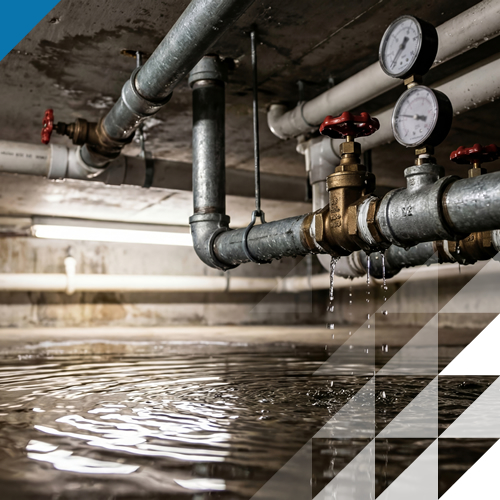
It's easy to underestimate water risk because, unlike fire, it rarely makes headlines. But the statistics tell a different story. Water damage is the most common type of insurance claim in the UK, accounting for around a third of all home insurance claims, and costs insurers an estimated £1.8 million every single day.
The picture is just as stark, if not worse, in the commercial sector where these claims can easily run into seven figures. The reasons are structural as much as anything else: commercial buildings such as offices carry increased risk through large heating and air conditioning systems and water coolers, and their stacked floor layouts mean a single leak on an upper floor can cascade damage through every storey below.
Costs are also rising. A total of £987 million worth of escape of water claims were made in the UK in 2022, with the average cost of repairing the damage climbing from £8,663 in 2021 to £12,791 in 2022 alone, driven by increases in the cost of labour and materials.
More recent data shows the trend continuing: water damage caused by leaks from plumbing, heating systems and appliances was the single most common cause of home insurance claims in 2025, accounting for nearly a quarter of all claims. Wider weather-driven escape of water and burst pipe claims also contributed to a record-breaking year for the UK insurance industry, with insurers paying out £6.1 billion in property claims in 2025 alone.

What makes water damage particularly insidious is how it compounds. Beyond the immediate physical damage to floors, walls, IT equipment, and stock, building owners often face the additional costs of temporary relocation, lost working hours, lost revenue, and—in sectors such as data centres and financial services—damage that can run into millions of pounds within minutes.
A data centre outage, for example, can cost upwards of £12,000 a minute once systems go down, while gradual leaks that go undetected behind walls or beneath raised floors can also lead to long-term issues such as mould growth and structural deterioration that are far more expensive to put right than the original leak.
There's also a less visible cost: the impact on your insurance position. Due to the rising scale of escape of water claims, insurers are increasingly scrutinising how property owners manage this risk, applying higher premiums and excesses where there's a history of issues, and in some cases becoming involved at the design and construction stage to ensure adequate protections are specified from the outset. In short, having a robust leak detection strategy isn't just good practice—it's becoming an expectation.
The fundamental challenge with water leaks is that, unlike fire, they're often invisible until significant damage has already occurred. A pipe can fail behind a wall, under a raised floor, or within a ceiling void, and by the time a leak becomes visible—a stain on a ceiling tile, water pooling on a floor, a damp smell—substantial damage may have already been done.
This is where automatic leak detection systems prove their worth. Rather than relying on someone physically discovering a leak, often long after it has started, these systems continuously monitor vulnerable areas and alert building management the moment moisture is detected. The faster a leak is identified and isolated, the smaller the resulting damage, disruption, and cost.
This principle becomes even more important for buildings housing high-value, sensitive, or irreplaceable assets. Data centres, museums, archives, and heritage buildings cannot simply replace what's lost if water reaches server racks, historic artefacts, or important documents. For these environments, the difference between detecting a leak in seconds versus discovering it hours later isn't just financial—it can be the difference between a minor incident and an irreversible loss.
At their core, water leak detection systems share a similar principle to fire detection: a central control panel connected to a network of sensors continuously monitoring an area; when a hazard is identified, the system raises an alarm and can trigger an automated response. There are two main types of detection methods used within these systems -point detection and linear detection.
Systems generally fall into two broad categories. Conventional systems are built around a simpler control panel covering a defined number of zones, and tend to suit smaller or less complex installations where straightforward, cost-effective protection is the priority.
Addressable systems offer much greater coverage and can pinpoint the precise location of a leak within a large or complex site, often with the ability to integrate into a BMS and configure sophisticated cause-and-effect responses. The right choice depends largely on the scale of the building, the number of areas requiring protection, and how critical rapid, precise location reporting is to minimising damage.

Monitors all of the connected probes and water leak detection cables, activates notification devices on detection of a leak, displays locational data of the device activated, controls external equipment such as switches and valves via outputs. Contains back-up batteries to provide continual coverage, even during a power outage.

Individual sensors placed at specific locations where leaks are most likely to occur or where consequences would be most severe—beneath a server cabinet, next to a water tank, or near a pipe joint, for example. When the contacts on the probe come into contact with water, it triggers an alarm.

Uses a continuous sensing cable that can be run along skirting boards, beneath raised floors, or around the perimeter of a room. This approach is particularly useful for covering larger areas or tracing the route of pipework, since it can detect a leak occurring anywhere along its length rather than only at a single fixed point.
Many modern systems allow probes and cable to be combined within the same installation, giving building owners the flexibility to tailor detection precisely to the layout and risk profile of their building.
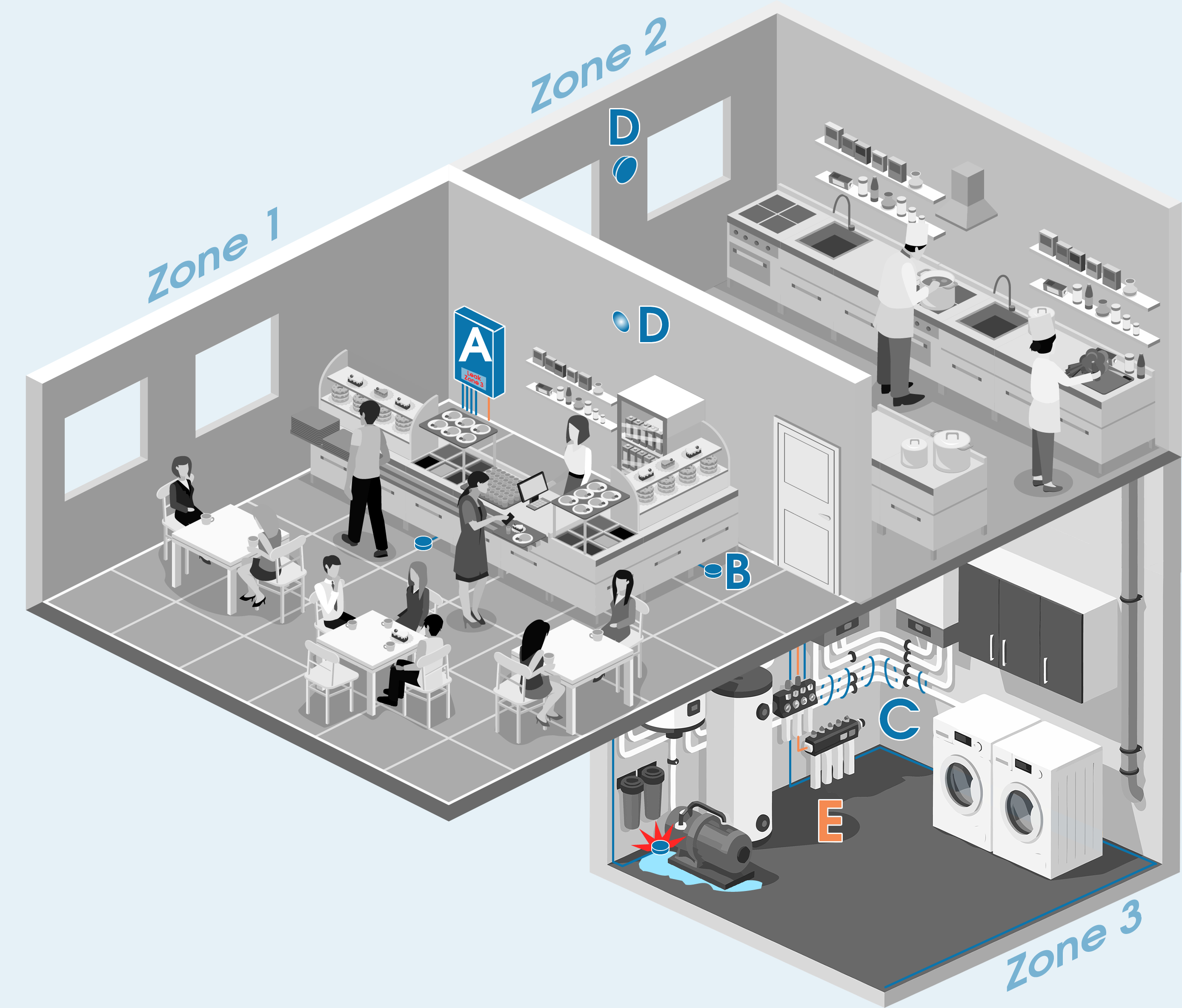

Once a leak is detected, the system's control panel registers the alarm and can trigger a range of responses depending on how it has been configured. This might include sounding a local voice alarm, illuminating a beacon to show the exact location of the leak, or sending a notification to a building management system (BMS) or directly to a smartphone.

In more advanced configurations the system’s panel outputs can automatically close switches or solenoid valves to shut off the water supply to the affected area on an activation, stopping the leak at its source before anyone needs to physically intervene.
While almost any building can benefit from leak detection, certain applications carry particularly high stakes.

face the dual risk of expensive equipment and significant business disruption from even a small amount of water ingress.

house items that are often irreplaceable, where even minor water exposure can cause permanent loss.

cannot afford disruption to critical care areas or sensitive equipment.

are common sources of leaks due to the concentration of pipework and mechanical equipment, often in areas that aren't visited frequently enough to catch problems early.

are particularly vulnerable, since leaks in these areas can go unnoticed for extended periods and often coincide with valuable stored goods.

benefit from early warning, since leaks can affect multiple units before being discovered, and modern construction methods using less robust materials have contributed to a rise in claims within this sector.

Selecting the right water leak detection solution isn't simply a matter of picking a product off a shelf. A few key considerations will help ensure you choose a system that genuinely fits your building's needs:

Consider how many areas need monitoring, how large those areas are, and whether you need the precise zone-level reporting of an addressable system or whether a simpler conventional system will suffice. Larger or higher-risk sites generally justify the investment in an addressable solution.
Decide whether point detection, linear detection, or a combination of both is most appropriate for each area. A small plant room might only need a handful of probes, while a large open-plan area with extensive pipework may benefit more from cable-based linear detection.
Think about whether you need the system to connect with your BMS, trigger automatic shut-off valves, or send alerts to specific personnel. These integrations can significantly reduce response times but need to be planned into the system design from the outset.
Check that any system you choose offers adequate battery backup, ideally with an extended standby period, so monitoring continues uninterrupted during a power failure—often when leaks are most likely to occur.
For buildings that aren't staffed around the clock, the ability to receive alerts remotely via BMS connectivity or cellular notification is essential to ensure a fast response regardless of when a leak occurs.
Given the increasing scrutiny insurers are placing on escape of water risk, it's worth discussing your proposed system with your insurer or broker at the design stage. In some cases, demonstrating a robust detection and isolation strategy can have a positive impact on premiums and terms.
As with any life safety or property protection system, working with experienced installers who understand your building's specific risks will ensure detection points are positioned where they'll be most effective, rather than simply meeting a minimum specification.
Water damage may not carry the same immediate danger to life as fire, but its financial and operational impact on UK buildings is significant and continues to grow. With insurers paying out staggering sums each year and commercial claims regularly reaching seven figures, the case for proactive water leak detection has never been stronger.
Whether you're protecting a small plant room or a large data centre, the principle remains the same: early detection limits damage, reduces disruption, and protects both your assets and your bottom line. By understanding how these systems work and carefully considering your building's specific needs, you can make an informed choice about the right level of protection for your property.

This article is part of our "Hochiki On" educational Fire Safety series, designed to help building owners understand modern life safety technologies. For more information about life safety solutions, please explore our other educational resources or contact our technical support team.
Get in touch
Quick links
Information
Hochiki Europe (UK) Ltd
Grosvenor Road, Gillingham Business Park, Gillingham, Kent ME8 0SA
Main switchboard +44 (0)1634 260133 | email [email protected]


