Hochiki On... Understanding UL Addressable Fire Detection

Part of our educational fire safety series for building owners, this article explains what a UL Listed addressable fire detection system is, how it works, its key features and benefits, and the US standards that govern its design, installation, and maintenance.
hochiki_on_article_08_web_page_header_2048x1024

What Is a UL Listed Addressable Fire Detection System?

A UL Listed addressable fire detection system is the modern standard for commercial fire protection in the United States and other regions, designed to give building owners and first responders precise, device-level information about a fire condition anywhere in a facility. Unlike conventional systems, which only identify which zone or circuit has activated, addressable systems can pinpoint the exact device that has triggered the alarm, dramatically improving response times and reducing unnecessary evacuations.

"UL Listed" 

means the equipment itself — the control panel, detectors, notification appliances and accessories — have all been independently evaluated by Underwriters Laboratories and found to meet the relevant product safety standards. 

"Approved"

refers to a decision made by the Authority Having Jurisdiction (AHJ) — typically the local fire marshal or building official — that a specific installation is acceptable for use in a specific building. A system is normally both: built from UL Listed components, installed to the NFPA 72 code, and then approved by the AHJ following inspection and testing.

Understanding this distinction matters, because product listing and system approval are two separate steps, both of which are required before a system can be placed into service.

How Addressable UL Systems Work

At its core, a UL addressable fire detection system operates through a network of individually identifiable devices connected to a central control panel. Here's how the system functions:

Fire Alarm Control Unit (FACU)

The heart of the system, the FACU is a UL 864 Listed control and indicating panel that continuously monitors every connected device, processes incoming signals, and directs the system's responses — from local notification appliances (sounders) to alarm signals sent off-site.


Signalling Line Circuit (SLC)

Devices connect to the FACP via one or more Signalling Line Circuits (commonly referred to as addressable loops within the UK and European fire industry). This wiring configuration supports two-way, supervised communication between the panel and each device on the circuit.


Intelligent Monitoring

The system constantly polls the status of every device, checking for alarm conditions, faults, chamber contamination, and other performance data in real time.


Precise Alarm Identification

When a device detects a potential fire condition, it reports its specific address to the FACP, which displays the exact device type and location, allowing staff and responders to go straight to the source.


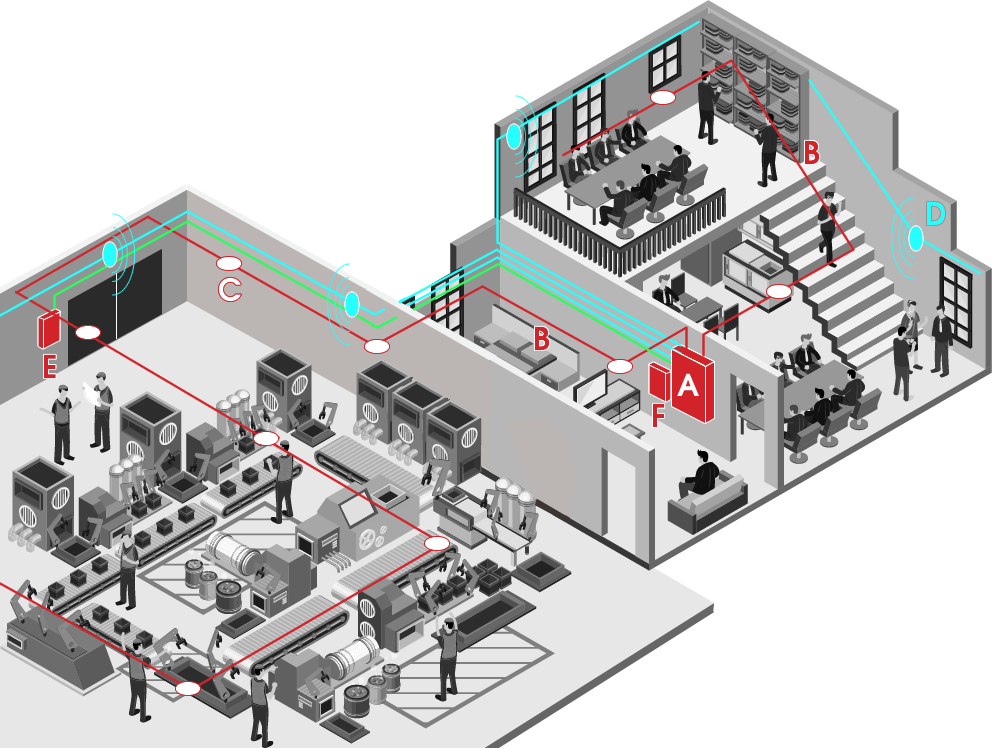
Key Components of a UL Listed Addressable System

A

Fire Alarm Control Unit (FACU)


Commonly also referred to as "FACP" (Fire Alarm Control Panel), this is the UL 864 Listed brain of the system.

B

Signalling Line Circuits (SLCs)


The addressable loops connecting devices to the panel.

C

Initiating Devices


The addressable smoke sensors, heat sensors, duct detectors, pull stations, and waterflow/tamper switches.

D

Notification Appliances


The horns, strobes, and combination horn/strobes that alert building occupants of an alarm condition.

building_layout_ul_system_2

A

Standby Power


Batteries sized to support the system through a defined standby and alarm period in the event of a mains power failure.

E

Remote Annunciators


Secondary displays, often at a fire department entrance, repeating panel status.

F

Off-Premises Transmission Equipment


The digital alarm communicator, IP communicator, or radio equipment linking the system to a central or remote supervising station.

UL Listing: The Product Compliance Backbone

Every major component of a US fire alarm system is evaluated against its own dedicated UL product safety standard before it can be installed.  The most common standards are:


UL 864 Control Units and Accessories for Fire Alarm Systems, covering the FACU itself
UL 268 Smoke Detectors for Fire Alarm Systems
UL 521 Heat Detectors for Fire Protective Signalling Systems
UL 38 Manually Actuated Signalling Boxes (pull stations)
UL 464 Audible Signalling Appliances
UL 1971 Visual Notification Appliances, including strobes for the hearing impaired
UL 2572 Mass Notification Systems, where an addressable fire system is integrated with wide-area emergency communication.


A system built entirely from components listed to these standards, and listed as compatible with one another, installed and tested in accordance with NFPA 72, and accepted by the AHJ, gives building owners a complete, verifiable chain of compliance from product to installation to ongoing operation and maintenance.


Key Features and Benefits of Addressable UL Systems

ul_location2

Enhanced Location Precision

The system identifies exactly which device has activated and where it is located within the building. This precision significantly reduces search time during an emergency and helps responding crews go directly to the affected area.

ul_verified_alarm_2

Intelligent Alarm Verification

Modern addressable systems can verify alarm conditions through several methods, including: Cross-zoning or coincidence detection (requiring two detectors to activate before a full alarm is raised), Pre-alarm and supervisory signals for investigation before full evacuation, and Drift compensation, which adjusts sensitivity thresholds as detectors age or accumulate dust.

ul_false_alarm3

Reduced False Alarms

Built-in intelligence reduces unwanted activations through: Individual device sensitivity settings, Environmental compensation for dust, humidity, and airflow, and Verification and pre-alarm capabilities.

ul_24_hr_monitoring

System Health Monitoring

The system continuously supervises itself, alerting maintenance staff to: Sensors requiring cleaning or nearing their sensitivity limits, Component or wiring faults and Standby battery condition.

programming_UL

Flexible Programming

Addressable systems can be programmed with a documented sequence of operations, including: Phased or staged evacuation for high-rise and large-footprint buildings, Custom notification sequences by zone or floor, and Integration with HVAC shutdown, door release, elevator recall, and other life-safety functions.

scalability_ul

Scalability

The system can expand as building needs change: Additional devices can be added to existing SLC loops within their listed capacity, Minimal rewiring is needed for expansion and Networking capability supports multi-building and campus-wide systems.

Advantages for the Building Owner

Daily Operation

Under normal conditions, the FACP displays a "system normal" status. Many addressable panels can run automatic self-diagnostic checks — a capability NFPA 72 specifically recognises when setting inspection schedules (see below).

During an Alarm Event

When a device activates:

1 2 3 4
 The control panel displays the exact device location, type, and address   The system executes its pre-programmed sequence of operations   Building staff can quickly investigate the specific location identified   The supervising station receives precise information about the incident type and location, and informs the fire department and others as required by the emergency response plan. 


Maintenance Benefits


Addressable systems reduce maintenance time and cost by offering:

  • Specific fault identification, eliminating point-to-point troubleshooting

  • Remote diagnostics

  • Historical event logging to support troubleshooting and compliance records

  • Early warning of devices approaching their sensitivity limits

Is a UL Addressable System Right for Your Building?


UL Listed addressable fire detection systems are particularly valuable for:

  • Medium to large commercial buildings

  • Multi-storey and high-rise structures

  • Buildings with complex layouts or multiple fire compartments

  • Facilities requiring phased or staged evacuation

  • Healthcare, senior living, and other occupancies housing people who need assistance evacuating

While the upfront cost of an addressable system is typically higher than a conventional system, the lifetime cost is often lower thanks to fewer false alarms, faster fault-finding, reduced downtime, and — in many jurisdictions — reduced inspection labour where automatic self-test capability is recognized by the AHJ.

NFPA 72: Your Compliance Framework


NFPA 72, the National Fire Alarm and Signalling Code, is the standard that governs the application, installation, location, performance, testing, and maintenance of fire alarm systems in the United States.

Where BS 5839 provides the code of practice in the UK, NFPA 72 performs the equivalent role for UL installations, and is incorporated by reference — usually via adopted codes such as the International Fire Code or International Building Code — by state and local jurisdictions.

nfpa72_book
System Types


NFPA 72 classifies systems by how an alarm signal is transmitted beyond the protected premises:

Protected Premises (Local) Systems — alarm, fault, and supervisory signals are enunciated only at the protected premises. All systems include local annunciation of events.

Remote Supervising Station Systems — signals are transmitted to a remote supervising station that has experienced operators who, upon receipt of a signal, take action as required by the Code.

Proprietary Supervising Station Systems — signals are monitored at a supervising station owned and operated by, or for, the owner of the protected premises (common on campuses and large complexes).

Central Station Systems — signals are transmitted to a UL Listed central station, staffed around the clock, which retransmits alarms to the fire department.

Your addressable system must be designed and installed to match the correct system type for your building and risk profile, as determined during the design process and agreed with the AHJ.

Advantages of Addressable Systems for NFPA 72 Compliance

fault_response_ul

Enhanced Fault Reporting

Immediate identification of the specific device at fault.

event_log_ul

Detailed Event Logs

Automatic, time-stamped recording of every system event.

predictive_maintenance_ul

Reduced Inspection Burden

Code-recognised reduction in visual inspection frequency for systems with automatic self-test.

ul_false_alarm3

False Alarm Reduction

Verification features reduce unwanted activations and the investigation burden that follows.

testing_ul

Testing Efficiency

Individual devices can be tested without disrupting the wider system.

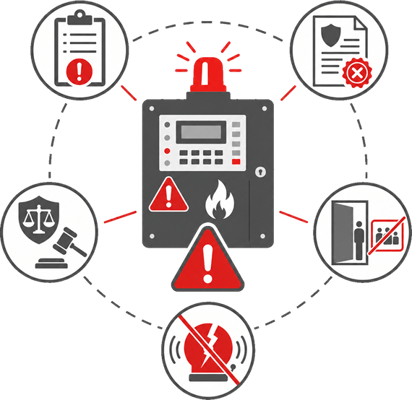
Non-Compliance Consequences


Failure to properly install, test, or maintain a UL fire alarm system can result in:

  • Citations or penalties from the AHJ

  • Invalidation of building insurance

  • Civil or criminal liability in the event of fire-related injury or loss of life

  • A prohibition on occupancy of all or part of the building until deficiencies are corrected

Most critically, a poorly maintained system may simply fail to perform when it matters most.

copilot_graphic_non-compliance_smaller

Documentation Requirements


NFPA 72 requires a Record of Completion — a detailed document confirming the system has been designed, installed, and tested in accordance with the code — along with:

  • As-built drawings and device layout plans

  • A written sequence of operations

  • Installation and acceptance test certificates

  • Inspection, testing, and maintenance (ITM) records

  • Battery calculations and standby power documentation

An addressable system's automatic event logging makes assembling and maintaining these records considerably easier than with a conventional system.

The Role of the Building Owner and the AHJ


Unlike the UK's single named "Responsible Person(s)," US fire code places the general duty to maintain life safety systems on the building owner, while the Authority Having Jurisdiction — typically the local fire marshal — approves the system design, witnesses acceptance testing, and enforces ongoing compliance.

Inspection, testing, and maintenance work itself is generally performed by qualified technicians, often NICET-certified, working for a licensed fire alarm contractor.

Legal Duties for System Maintenance

NFPA 72 sets out a detailed inspection, testing, and maintenance schedule. Frequencies vary by component, but the framework generally includes:

Monthly — functional checks of specific auxiliary equipment


Quarterly — inspection of radiant energy and other fire detectors


6-Monthly — visual inspection and battery tests


Annually — full functional testing of every initiating device and notification appliance, and a complete system evaluation by a qualified technician


Every 2 Years — smoke detector sensitivity testing, required within one year of installation and every alternate year thereafter

Where an addressable system performs automatic self-diagnostic checks at least weekly and can produce a printed or electronic record of those checks, NFPA 72 allows some visual inspections to be conducted annually rather than 6-monthly — a direct, code-recognised benefit of choosing an addressable system 


predictive_maintenance_ul


Developing A Maintenance Strategy

To meet these obligations, building owners should consider:

service_agreement_ul

A Service Agreement

With a licensed fire alarm contractor, experienced with UL addressable systems.

predictive_maintenance_ul

A Maintenance Calendar

Covering all monthly, quarterly, 6-monthly, and annual requirements.

electrical_fault_icon_2_ul

A Fault Response Protocol

Defining how different trouble/fault conditions are handled, and by whom.

training_2_ul

Staff Training

So on-site personnel understand system operation, and how to respond to alarm and trouble signals.

event_log_ul

A Complete System File

Including as-built drawings, the Record of Completion, all test certificates, and contractor contact details.

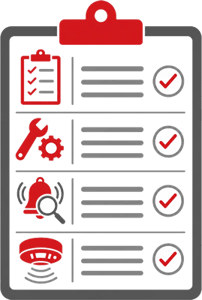
Maintenance Records


Owners must maintain detailed records of:

  • All inspections, tests, and their results

  • Any faults identified and the remedial action taken

  • False alarm incidents and subsequent investigation

  • Sensitivity test results for each smoke detector

maintenance_records_smaller_ul