Hochiki On... Understanding Voice Alarm Systems

In this educational article, we explore voice alarm systems and PA/VA (Public Address/Voice Alarm) systems—what they are, how they work, and why they're becoming increasingly important in modern buildings, particularly in light of new legislation such as Martyn's Law.


hochiki_on_article_05_web_page_header_4096x2048

What is a Voice Alarm System?

When an alarm sounds in your building, how do your occupants respond? Research shows a striking difference: while only 13% of people react promptly to traditional alarm bells, an impressive 75% respond quickly and appropriately to clear voice messages. For building owners and facility managers, this difference can be critical in protecting lives and property.

A voice alarm system replaces or supplements traditional fire alarm bells and sounders with clear, spoken instructions. Instead of hearing only a generic alarm tone, building occupants receive specific guidance such as "A fire has been detected. Please evacuate the building using the nearest exit."

Key characteristics of voice alarm systems:
  • Its primary purpose is to provide life safety during emergencies

  • All equipment must be certified to BS EN54 standards

  • The system must be connected directly to the fire detection system for automatic activation

  • Must be designed in such a way as to operate during emergencies with battery backup power if required

  • Must be installed according to BS 5839 Part 8

Voice alarm systems are particularly valuable in buildings where:
  • Occupants may be visitors and therefore unfamiliar with evacuation procedures (hotels, shopping centres, transport hubs)

  • Phased evacuation of complex buildings is necessary (high-rise buildings)

  • Clear instructions would prevent panic and confusion (educational facilities, healthcare settings, care homes)

What is a PA/VA System?

A PA/VA (Public Address/Voice Alarm) system combines the life-saving features of a voice alarm with the everyday utility of a public address system. Think of it as a voice alarm system that does more than just emergency communications.

Dual functionality:

Voice Alarm (VA) mode:
During emergencies, the system broadcasts pre-recorded (or live) evacuation instructions, automatically overriding any other use.

Public Address (PA) mode:
During normal operations, the system can be used for routine announcements, background music, and general building-wide communication.

voice_alarms_02

Benefits of integrated PA/VA systems:

cost efficient-1

Cost-effective

One system serves multiple purposes, reducing installation and maintenance costs.

space_saving

Space-saving

Eliminates the need for separate speaker systems throughout the building.

flexible_zoning

Flexible Zoning

Different areas can receive different messages simultaneously.

How Voice Alarm and PA/VA Systems Operate

System Architecture

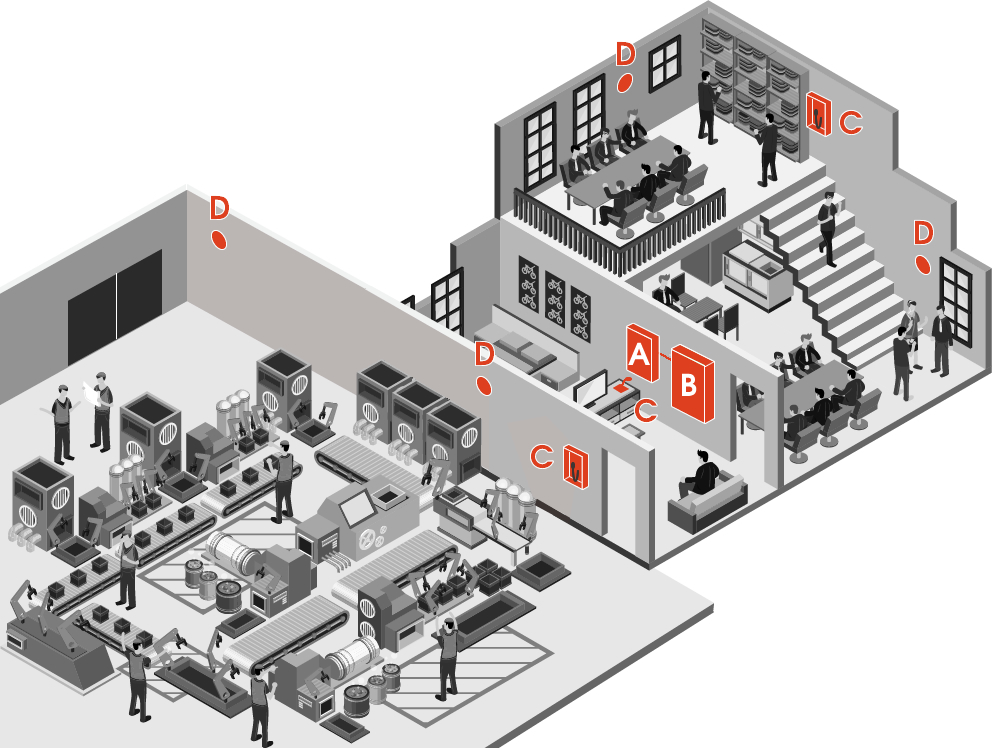
Modern voice alarm systems typically consist of:

building_layout_voice_alarms_no_bg
A2_voice

Central controller or rack-mounted amplifiers

B2_voice

Integration with fire alarm control panel

C2_voice

Emergency microphone stations for live announcements

D2_voice

Monitored loudspeaker circuits throughout the building

Other Features:
  • Zoned coverage allowing targeted or building-wide broadcasts

  • Fully supervised cabling that alerts operators to any faults

  • Mains power supply with automatic battery backup

  • Designed to continue operating during power failures

voice_alarms_01

Types of Voice Alarm Systems

According to BS 5839-8, voice alarm systems are classified into five types:

automatic_voice

Type V1 - Automatic Evacuation

Fully automatic operation with pre-programmed evacuation messages. May include manual activation of non-fire emergency messages that are automatically overridden by fire signals.

evacuation

Type V2 - Live Emergency Messages

Includes all V1 features plus emergency microphones for broadcasting live instructions during evacuation, allowing trained staff to provide supplementary guidance.

flexible_zoning

Type V3 - Multiple Alarm Zones

Provides the capability for phased evacuation, where different areas receive different instructions at different times—essential (and in some regions, mandatory) for dealing with fire incidents within high-rise buildings.

intercom

Type V4 - Intercom Facilities

Adds two-way communication capability, typically used in complex buildings requiring coordination between multiple control points.

live_messages

Type V5 - Public Address Integration

A full PA/VA system combining all voice alarm functionality with every day public address capabilities for announcements and background music.

Typical Operation Sequence

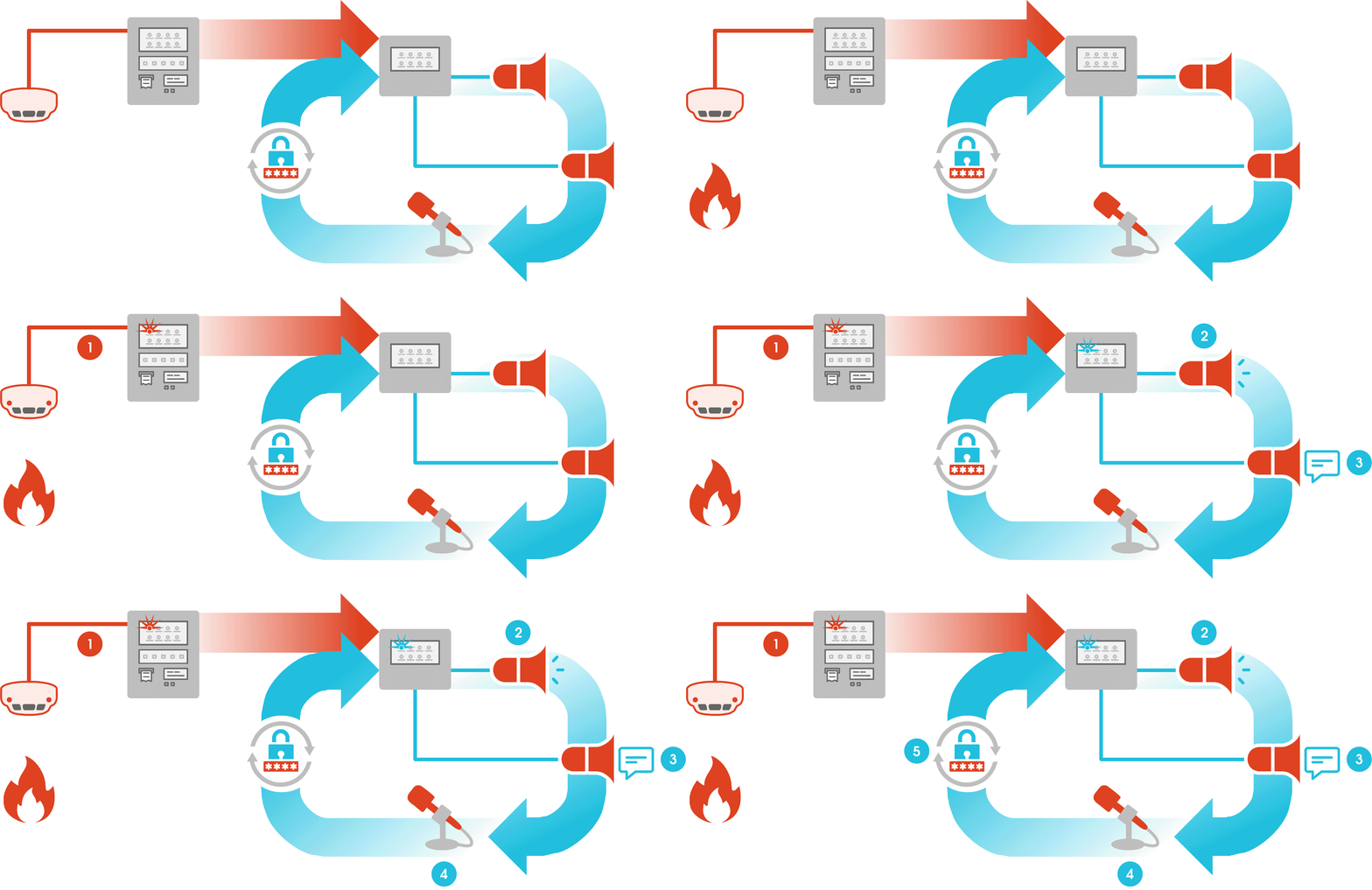
When a fire is detected:


operation_sequence_anim_2
voice_1

Detection

A smoke detector, heat detector, or manual call point triggers the fire alarm.

voice-2

Alert Tone

The system broadcasts an attention-getting tone throughout the building or relevant zones.

voice_3

Voice Message

A pre-recorded message provides clear evacuation instructions.

voice_4

Live Override

If needed, trained staff can use emergency microphones to broadcast live instructions.

voice_5

Continuous Operation

Messages repeat until the system is reset by authorised personnel.

 This entire process is monitored continuously. Any fault—such as a broken speaker cable or amplifier failure—is immediately signalled to building management. 

Key Features of Modern Voice Alarm Systems

intelligible_messages

Message Intelligibility

High-quality loudspeakers and strategic placement ensure messages are clearly understood, even in acoustically challenging environments or areas with high background noise.

flexible_zoning

Zonal Broadcasting

Buildings can be divided into zones, allowing: Phased evacuation (evacuating floor by floor in tall buildings), targeted messages (warning only affected areas) and different instructions for different building areas.

automatic_voice

Automatic and Manual Operation

Automatic activation based on fire alarm input, with manual triggering available (by authorised personnel only), emergency microphones for live announcements and pre-recorded messages for consistency.

monitored

Continuous Monitoring

Fully automatic operation with pre-programmed evacuation messages. May include manual activation of non-fire emergency messages that are automatically overridden by fire signals.

priority

Priority Hierarchy

Emergency messages automatically override all other uses: Fire evacuation messages (highest priority), other emergency messages (security, severe weather) and routine PA announcements (automatically muted during emergencies).

reliability

Redundancy and Reliability

Battery backup power supply, redundant amplifiers in critical systems, no single point of failure in networked systems, and designed for 24/7 operation.

Martyn's Law and Voice Alarm Systems in Schools

midpage_banner_voice

What is Martyn's Law?

Martyn's Law, formally known as the Terrorism (Protection of Premises) Act 2025, received Royal Assent in April 2025. Named in memory of Martyn Hett, a victim of the 2017 Manchester Arena attack, this legislation introduces new duties for publicly accessible premises, including schools, to enhance preparedness for potential terrorist threats.

The law establishes a 24-month implementation period, with full compliance required by April 2027.

How Martyn's Law Affects Schools

All schools, regardless of capacity, fall under the "Standard Tier" of Martyn's Law. This recognises that educational settings already maintain robust safeguarding and health and safety procedures but require additional specific measures for specific security emergencies.

The Four Required Procedures:

Evacuation:

Moving people safely out of the building

Invacuation:

Bringing people into safer internal areas to protect from external threats

Lockdown:

Securing the site by locking doors and preventing movement

Communication:

Alerting everyone on site to danger and providing clear instructions

How Voice Alarm Systems Support Martyn's Law Compliance

The above communication requirement is where PA/VA systems become particularly relevant. Martyn's Law requires schools to have effective systems for alerting staff and students during various emergency scenarios— not just fires, but also security threats.


Scenario-Specific Instructions

Unlike a fire alarm bell that only signals "evacuate," a voice alarm system can broadcast different messages for different emergency types:

  • Fire evacuation: "A fire has been detected. Please evacuate the building calmly using the nearest exit."

  • Lockdown: "This is a security alert. Teachers, please secure your classrooms and keep students inside."

  • All-clear: "The emergency has ended. Normal activities may resume."

Clarity in Crisis

Voice messages significantly reduce confusion and panic, particularly among young students who may not understand what different alarm sounds mean. Clear instructions help both staff and students respond appropriately.

Flexible Response

PA/VA systems allow for both pre-recorded messages and live announcements. School leadership can provide real-time updates and specific instructions as situations develop, which is particularly important during evolving security incidents.

Zonal Control

Modern PA/VA systems can broadcast to specific areas or zones which means the system can:

  • Alert only certain buildings on multi-building campuses

  • Communicate with outdoor areas where students may be during breaks

  • Provide different instructions to different zones (e.g., "shelter in place" for some areas, "evacuate" for others).


Testing and Familiarity

Because PA systems are used daily for normal school announcements, students and staff are already accustomed to hearing and responding to voice messages over the system, improving engagement and response times during actual emergencies.

school_graphic_voice_2

Standards and Compliance

For systems used to communicate during emergencies, the Institute of Sound, Communications and Visual Engineers (ISCVE) advises that any system implemented for Martyn's Law compliance must be regarded as a "Sound System for Emergency Purposes" (SSEP) and comply with BS EN 50849.

Where the same system also serves as the fire evacuation system (as in most PA/VA installations), it must additionally comply with BS 5839-8 and utilize BS EN54 certified equipment.

This ensures:

  • Reliable operation during emergencies

  • Clear, intelligible message delivery

  • Continuous system monitoring and fault reporting

  • Integration with building safety systems

  • Professional design and installation standards

Choosing Between Voice Alarm and PA/VA Systems

For building owners and facility managers, the decision typically depends on several factors:

voice_alarm_table_header

When a Voice Alarm System is Appropriate:
  • Required by fire risk assessment

  • Building uses a phased evacuation strategy

  • Occupants are unfamiliar with the building (hotels, transport hubs)

  • No regular need for public address functionality

  • Primary concern is fire safety compliance

pava_alarm_table_header
When a PA/VA System Offers Additional Value:
  • Building can benefit from daily PA functionality (schools, offices, retail)
  • Multi-purpose use justifies the investment
  • Compliance with both fire safety and security legislation (e.g., Martyn's Law)
  • Regular system use ensures operational readiness
  • Space and budget favour integrated systems
Key Considerations:
buildings_type
 
Building Type and Occupancy
  • What types of emergencies might occur?
  • How familiar are occupants with the building?
  • Are there special populations (children, elderly, disabled)?

evacuation

Evacuation Strategy
  • Simultaneous evacuation or phased?

  • Multiple exit routes requiring different instructions?

  • Need for live announcements during evacuation?

daily_operations

Daily Operations
  • Would PA functionality benefit normal operations?

  • Are routine announcements currently challenging?

  • Is background music or scheduled messaging desired?

regulatory_voice
 
Regulatory Requirements
  • What does the fire risk assessment recommend?

  • Are there specific industry or occupancy regulations?

  • Does Martyn's Law or similar legislation apply?

budget
 
Budget and Resources
  • What are the total costs of installation and maintenance?

  • Can one integrated system replace multiple separate systems?

  • What training is required for operators?

Maintenance and Testing

Voice alarm and PA/VA systems are life safety systems requiring regular maintenance to ensure reliability.

Regular Maintenance Schedule:
Weekly:
  • Test system operation from control point

  • Verify battery backup status

  • Check for any fault indicators

Monthly:
  • Test message playback in all zones

  • Verify emergency microphone function

  • Inspect control equipment and connections

Quarterly:
  • Test battery backup operation

  • Verify loudspeaker operation throughout building

  • Check message intelligibility in challenging areas

Proper maintenance not only ensures regulatory compliance but also provides confidence that the system will operate correctly when needed most.

Annually:
  • Full system testing by qualified technician

  • Battery load testing and replacement if needed

  • Documentation of system performance
    Update of any pre-recorded messages if needed

Conclusion

Voice alarm and PA/VA systems represent a significant advancement in building safety communication. By replacing confusing alarm bells with clear, instructive voice messages, these systems dramatically improve occupant response during emergencies.

For schools and other public buildings facing new requirements under Martyn's Law, PA/VA systems offer a comprehensive solution that addresses both fire safety and security communication needs. For other building types, they provide enhanced safety while offering valuable everyday functionality.


As building owners and facility managers consider their life safety systems, understanding the capabilities and benefits of voice alarm technology is essential. While the initial investment may be higher than traditional alarm bells or electronic sounders, the improved safety outcomes, operational flexibility, and potential for multi-purpose use make voice alarm systems an increasingly valuable choice for modern buildings.

The key is working with experienced fire safety professionals who can assess your specific building requirements, recommend the appropriate system type, and ensure compliant design and installation. Your building's occupants deserve clear communication during emergencies—and a suitable voice alarm system can deliver precisely that.