Hochiki On... Understanding Emergency Lighting Systems

Part of our educational life safety series for building owners, this article explains what an emergency lighting system is, how they work, their key features and benefits and why your building legally needs one. 

hochiki_on_article_03_web_page_header_4096x2048

What is an Emergency Lighting System?

Emergency lighting systems are life safety installations designed to provide illumination during power failures or emergency situations, ensuring safe evacuation routes remain visible when normal lighting fails. These systems are governed by strict European standards, particularly EN 50172 and EN 1838, which establish comprehensive requirements for design, installation, and maintenance to protect building occupants across the European Union.

For building owners, emergency lighting represents a critical life safety infrastructure that not only ensures compliance with legal requirements but also provides essential protection for occupants during crisis situations. Unlike standard lighting systems, emergency lighting operates independently of the main electrical supply, activating automatically when normal power is interrupted.
The Evolution of Emergency Lighting Technology

Emergency lighting has undergone significant technological advancement over recent decades. Early systems relied on basic incandescent bulbs powered by large lead-acid batteries, requiring frequent maintenance and offering limited operational life. Modern emergency lighting systems have evolved to incorporate LED technology, intelligent monitoring capabilities, and sophisticated battery management systems.

Contemporary systems feature self-testing capabilities, extended battery life, and improved energy efficiency. The introduction of LED technology has revolutionised emergency lighting by providing brighter illumination with significantly reduced power consumption, extending operational duration during emergencies while reducing maintenance requirements.

lighting_engineer_01

How Emergency Lighting Systems Operate

Emergency lighting systems function through a network of luminaires strategically positioned throughout buildings to ensure adequate illumination along escape routes, in high-risk areas, “points of emphasis” and in open spaces where occupants might congregate during evacuation. 


Types of System

battery-pack

Central Battery Systems

Based on a centralised array of high-powered batteries that feeds multiple emergency lights throughout a building through cabling.

electric-power

Mains-Powered Systems

Comprising mains-powered luminaires and exit signs that switch to a battery back-up in the event of a power failure.

battery_powered

Self-Contained Systems

Based on lighting and other field devices, designed to be self-contained, i.e. they feature integral batteries to power the units during an emergency.

Regardless of type, these systems typically comprise several key components:

A_icon

Maintained Luminaires:

Lights that operate continuously, switching to emergency power when mains supply fails.

B_icon

Non-Maintained Luminaires:

Lights that activate only during emergency situations, for example, down lights.

C_icon

Escape Route Luminaires:

Specific illumination designed to clearly mark evacuation paths and corridors.

D_icon

Open Space Luminaires:

Wide-area illumination to prevent panic in large spaces and enable safe evacuation.

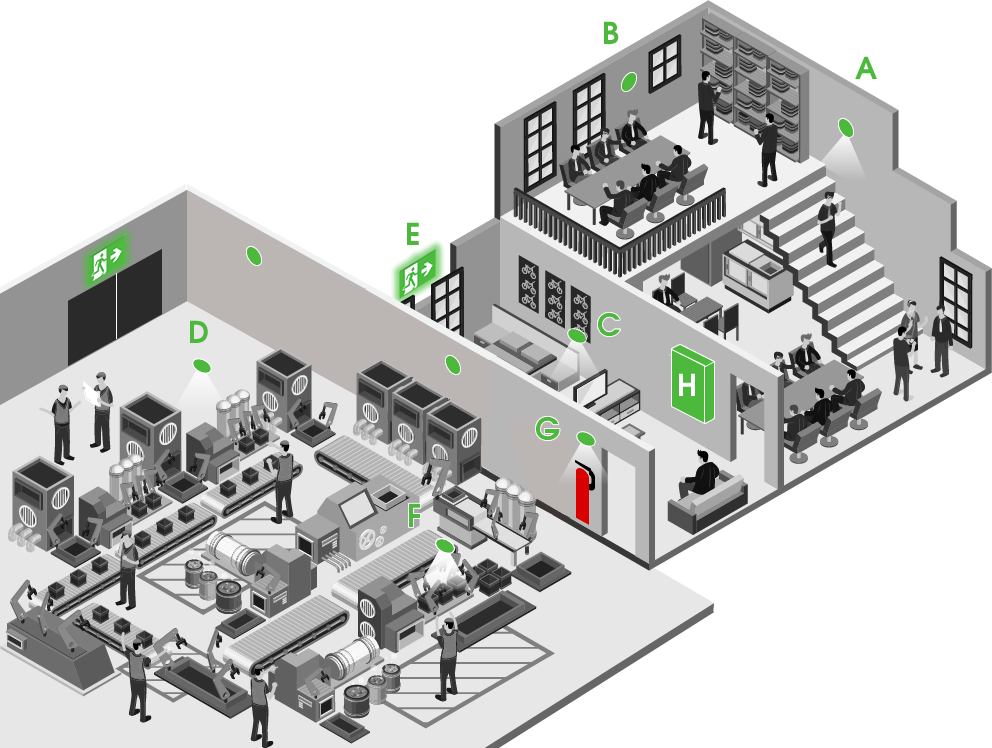
building_layout_emergency_lighting_02
E_icon

Exit Signs:

Illuminated directional signs designed to direct people to the nearest emergency exit.

F_icon

High-Risk Task Area Lighting:

Specialised lighting for areas where dangerous processes might need light in order to be safely shut down.

G_icon

Points of Emphasis Lighting:

Lighting is required in areas of the building that require specific items to be highlighted during a power cut, such as firefighting equipment, changes in floor level or direction, and medical stations.

H_icon

Lighting Control Panel:

Modern systems incorporate intelligent control units that continuously monitor system status, automatically conduct regular testing, and provide detailed reporting on system performance. These controls can integrate with building management systems to provide centralised monitoring and maintenance scheduling.

European Standards and Compliance Requirements

European emergency lighting systems must comply with rigorous standards that ensure consistent performance across all member states. The primary standards include:

Regulatory Reform (Fire Safety) Order 2005

Emergency lighting is a requirement under the Regulatory Reform (Fire Safety) Order 2005 (RRFSO) in all non-domestic buildings and in communal areas of HMO (houses of multiple occupancy). The purpose of emergency lighting is to illuminate emergency exits and escape paths in the case of a mains power failure. Article 14 (2) (h) of the RRFSO states that

“Emergency routes and exits requiring illumination must be provided with emergency lighting of adequate intensity in the case of failure of their normal lighting”.

exit_running_man_2
EN 50172

Establishes the requirements for emergency lighting systems, covering design principles, installation methods, and maintenance procedures. This standard defines minimum illumination levels for different areas and specifies duration requirements for emergency operation.

hourglass
EN 1838

Provides detailed photometric requirements, specifying exact illumination levels for escape routes (minimum 1 lux), open areas (minimum 0.5 lux), and high-risk task areas (minimum 10% of normal illumination or 15 lux, whichever is greater).

brightness (1)
EN 62034

Covers the requirements for automatic test systems, ensuring that emergency lighting systems can self-monitor and report their operational status without manual intervention.

en62034_self_testing
BS 5266-1: 2025

A British Standard that provides a code of practice for emergency lighting in buildings. It outlines recommendations for the design, installation, and maintenance of emergency lighting systems to ensure safe evacuation during power outages or other emergencies. The standard covers various aspects, including minimum illuminance levels, safety sign placement, and the selection of appropriate system types based on the building's characteristics and risk assessment.

Visit our Literature page to download a soft copy of our own guide to BS 5266-1 booklet.

bs5266_1

Correct understanding and adherence to these standards will ensure that emergency lighting systems provide adequate illumination for safe evacuation.  Typically, these systems are required to provide a minimum three-hour duration of emergency operation, though specific requirements may vary based on building type and occupancy so check your local standards and codes of practice.

search

Key Features of Modern Emergency Lighting

self_testing

Intelligent Self-Testing

Contemporary emergency lighting systems incorporate sophisticated self-testing capabilities that automatically verify system functionality at predetermined intervals. These systems conduct functional tests (brief activation to verify operation) and duration tests (extended operation to verify battery capacity) without manual intervention, maintaining detailed logs of all test results.

led

LED Technology Integration

Modern systems predominantly utilise LED technology, offering several advantages over traditional lighting: Extended operational life, often exceeding 50,000 hours, Reduced power consumption, extending battery operation time, Superior light quality with consistent colour temperature, Reduced heat generation, extending battery life, Improved durability and shock resistance

battery_tech

Advanced Battery Management

Current systems feature sophisticated battery management technology that optimises charging cycles, monitors battery health, and provides early warning of battery degradation. Lithium-ion batteries are increasingly replacing traditional nickel-cadmium units, offering improved performance and reduced environmental impact.

cloud_monitoring

Cloud-based Monitoring

Advanced systems can incorporate remote monitoring through cloud technology, allowing centralised monitoring of distributed emergency lighting installations. This technology enables facility managers to monitor system status, receive immediate fault notifications, and schedule maintenance activities across multiple sites, all from a central location.

Practical Applications and Building Types

 Emergency lighting systems are mandatory in virtually all commercial, industrial, and public buildings in most regions, with specific requirements varying based on building classification or local standards: 

commercial_buildings

Commercial Buildings

Offices, retail spaces, and shopping centres require comprehensive escape route lighting and open space lighting in large areas.

industrial_facilities

Industrial Facilities

Manufacturing plants and warehouses need high-risk task area lighting in addition to standard escape route illumination.

healthcare

Healthcare Facilities

Hospitals and care homes require extended duration systems and specialised lighting for critical areas.

System Design Considerations

Effective emergency lighting design requires careful consideration of several factors: 

Escape Route Analysis

Designers must identify all potential evacuation paths and ensure adequate illumination along each route, considering factors such as corridor width, stairwell configuration, change of floor level and exit door locations.

Occupant Load

Buildings with high occupancy levels may require enhanced open area lighting to prevent dangerous overcrowding during evacuation.

Risk Assessment

High-risk areas such as kitchens, plant rooms, or areas containing hazardous materials require specialised lighting solutions to ensure safe shutdown procedures can be completed during emergencies.

Building Layout

Complex building configurations may necessitate additional emergency lighting to ensure all areas remain adequately illuminated during evacuation.

Maintenance and Testing Requirements

European standards mandate regular maintenance and testing of emergency lighting systems to ensure continued compliance and operational reliability. Building owners must establish maintenance schedules that include:

  • Monthly brief functional tests of all emergency luminaires

  • Annual full-duration tests to verify battery capacity

  • Three-yearly comprehensive system inspection and maintenance

  • Immediate replacement of failed components

  • Detailed record-keeping of all testing and maintenance activities

Modern self-testing systems significantly reduce the administrative burden of compliance by automatically conducting required tests and generating electronic records, though periodic manual verification still remains necessary. 

Cost Considerations and Return on Investment

While emergency lighting systems represent a significant capital investment, building owners should consider the total cost of ownership, including installation, ongoing maintenance, and potential liability costs. Modern LED-based systems often provide favourable return on investment through:

  • Reduced energy consumption during normal operation

  • Extended component life reducing replacement costs

  • Lower maintenance requirements through self-testing capabilities

  • Improved reliability reducing emergency service calls

Future Developments

The emergency lighting industry continues to evolve with advancing technology. Emerging developments include dynamic signage, integration with building information modelling (BIM) systems, enhanced cloud-based communication capabilities, and improved battery technologies offering extended life and reduced environmental impact.

Conclusion

European emergency lighting systems represent a crucial component of building safety infrastructure, providing essential illumination to ensure safe evacuation during emergency situations. Understanding these systems enables building owners to make informed decisions about installation, maintenance, and compliance with European safety standards.

The combination of strict regulatory requirements, advanced technology, and professional installation ensures that properly designed and maintained emergency lighting systems provide reliable protection for building occupants. As with all life safety systems, consultation with qualified professionals remains essential to ensure appropriate system design and ongoing compliance with applicable standards.

hochiki_nepto_group