Hochiki's Environmental Initiatives

Including environmental management, climate change initiatives, resource conversation and performance data.

The Hochiki Group Basic Environmental Policy


Our Basic Philosophy

The HOCHIKI Group positions environmental problems as one of its major management issues, and will work to preserve and protect our planet through its global business activities and coordinate with different stakeholders to create a sustainable society. 

Action Guidelines

Established April 1, 2025
Hajime Hosoi
Representative Director, President and CEO 

teal triangle pattern

1. We will work to reduce greenhouse gas emissions across our supply chain to help mitigate climate change and achieve a carbon-free society.

teal triangle pattern

2. We will consider the environmental impact of our operations, with the importance of biodiversity, ecosystems, and water resources in mind.

teal triangle pattern

3. We will comply with international declarations regarding environmental preservation, and with environmental laws and regulations of the countries and regions where we conduct business operations.

teal triangle pattern

4. We will work to conserve resources and energy, reduce waste, and make effective use of resources.

teal triangle pattern

5. We will actively share our initiatives to foster communication with local communities and other stakeholders.

The Engineering & Production Division's Environmental Policy

The Engineering & Production Division, in charge of product development, has established the below environmental policy to reduce environmental impact. 

  1. The division will reduce the environmental impact of its development, production, and service activities with regard to comprehensive disaster prevention equipment, through such measures as resource-saving, energy-saving, and waste reduction.
  2. The division will help build a sound material-cycle society, and continue to work toward environmental improvement and pollution prevention.
  3. The division will comply with environmental laws, regulations, and agreements, and establish and follow its own voluntary standards.
  4. The division will set environmental objectives and goals, share environment-related information with its employees, and perform regular audits and reviews to maintain and improve its environmental conservation activities.
  5. The division will disclose is environmental policy, and contribute to the neighbouring communities and to society through environmental conservation activities.
Management Structure

At Hochiki, TCFD Promotion Subcommittee under ESG Management Subcommittee leads the development and implementation of measures to address environmental issues, including climate change.


This ESG Management Subcommittee is held quarterly and oversees KPI progress management and policy direction based on reports from the subcommittee. The outcomes of discussions by the Subcommittee are reported to the Sustainability Strategy Committee, which reviews them and makes decisions from a management perspective. The final outcomes of deliberations are reported to the Board of Directors, which promotes company-wide environmental initiatives under its oversight framework. 


Compliance with RoHS Directive*

Electrical and electronic products manufactured by Hochiki fall under the "monitoring and control instruments" RoHS Directive category. We have reviewed our frameworks for product design, production line, inspection, analysis, and so forth in time for the application deadline, and have achieved full compliance with the RoHS Directive for our products sold by Hochiki Europe (UK) Limited and Kentec Electronics Ltd. to EU and UAE markets.


Hochiki will press on with its efforts to achieve compliance with the RoHS Directive for Hochiki brand products (electric and electronic devices) sold not only to EU markets but everywhere else in the world as well. 

*RoHS Directive: Directive that limits the use of hazardous chemical substances (six substances, including lead and mercury) in electric and electronic devices in EU member states, incrementally enforced since July 2006. For the "monitoring and control instruments" category, the Directive is applied to products sold in EU member states from July 2014 onward. 

Aquisition Rate of Environmental Management System Certifications

Across our group, 71.4% of production sites are certified under ISO 14001.

ISO14001 Certification

Climate Change Initiatives

 
Basic Approach

In recent years, the issue of global warming has intensified, and severe weather has been causing natural disasters all over the world. With the impact of global warming expected to become even more widespread in the coming years, long-term and concrete measures are in order.
We support the long-term goals of the Paris Agreement and the Japanese government’s policies aimed at achieving carbon neutrality, and complies with applicable laws and regulations, including the Act on Promotion of Global Warming Countermeasures and the Act on the Rational Use of Energy. We also ensure that our activities are aligned with the goals of the Paris Agreement and take a consistent approach to climate change mitigation and adaptation across our sites in Japan and abroad.

 
Hochiki is a supporter of TCFD Recommendations 

The HOCHIKI Group has incorporated ESG elements into its medium-term business plan GLOBAL VISION 2030 as before, and has listed the environment as one of its key material issues. We announced our support of the TCFD Recommendations in June 2022, and are committed to disclose our information even more robustly in accordance with its four pillars TCFD Recommendations: governance, strategy, risk management, and metrics and targets.

The HOCHIKI Group will continue its work to enable environments where each and every person can be and feel safe to live their everyday lives, and to build a sustainable society. 

TCFD-Recommended Disclosures

We disclose climate change-related information, according to the following four pillars of the TCFD Recommendations.

Based on the TCFD framework, we collect and analyse data on the impact the risks and profit-making opportunities related to climate change may have on our business activities, profits, and other aspects; identify risks and opportunities; and verify the resilience of our strategy through scenario analysis. The current status is as follows. 

Source: Final Report; Recommendations of the Task Force on Climate-related Financial Disclosures.

teal triangle pattern

Governance

Hochiki's governance around climate-related risks and opportunities.

teal triangle pattern

Strategy

The actual and potential impacts of climate-related risks and opportunities on Hochiki's businesses, strategy, and financial planning.

teal triangle pattern

Risk Management

How Hochiki identifies, assesses, and manages climate-related risks.

teal triangle pattern

Metrics and Targets

The metrics and targets used to assess and manage relevant climate-related risks and opportunities.

Governance

Hochiki established its ESG Management Subcommittee to drive forward its efforts to tackle climate change. The Subcommittee examines and deliberates basic policies, critical issues, risks, opportunities, and other matters related to climate change. Details of these deliberations are reported to the Board of Directors every quarter, and targets, progress, and other aspects are monitored to ensure supervision over climate change risks. Decisions made by the Board of Directors are shared with relevant divisions and group companies, and reflected to their respective management plans and business operations. 


Strategy

The Company referred to the climate change scenarios (below 2C scenario and 4C scenario) of the IEA (International Energy Agency) and IPCC (Intergovernmental Panel on Climate Change), and conducted a scenario analysis to consider the long-term influence on the Company up to 2050. The outline of the influence on the Company's businesses is as follows:

Major risks and opportunities concerning climate change
Risk Management

Hochiki's Risk Management and Compliance Committee was established to help the company take control of and effectively manage risks across the HOCHIKI Group.

There are two kinds of climate change risks: transition risks and physical risks. Transition risks are risks related to market changes and the tightening of policies and regulations needed to achieve a carbon-free society. Physical risks are risks related to the acute and chronic changes brought about by global warming.


Climate change risks are mainly deliberated by the ESG Management Subcommittee and its subsidiary, the TCFD Promotion Subcommittee. The two committees analyze the risks, draft and promote measures, and manage progress, among other things.
Going forward, the ESG Management Subcommittee and Risk Management and Compliance Committee will work together to build a company-wide framework for risk management. 


Metrics and Targets

In view of global warming becoming a threat for the whole society, for Scopes 1 and 2 (business activities of the Company itself), the Company sets forth the objectives to decrease CO2 emissions by 2030 by 30% from 2019, and decrease the same to substantially zero in order to create a carbon neutral society by 2050.


Resource-Saving Through Renewable Energy

Hochiki has switched 100% of purchased electricity to renewable energy at its two domestic production sites, with the Machida Office beginning in February 2025 and the Miyagi Office in April 2025.

The Miyagi Office has been using wind and solar power generation facilities since June 2009 to supply electricity for production activities and reduce greenhouse gas emissions.
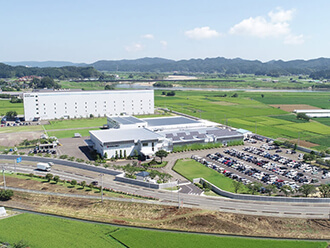
Miyagi Office

Resource Conservation Initiatives

We promote initiatives for resource conservation to ensure the effective use of finite resources, reduce environmental impacts, and support the realization of a sound material-cycle society. Along with optimizing product design and production processes, we will promote recycling to reduce waste and make effective use of water resources, aiming to balance business activities with environmental conservation and help realize a sustainable society. 

Waste Reduction

*1. Enforced on April 1, 2022, this Japanese law promotes resource circulation across the entire lifecycle of plastic products, from design and manufacturing through disposal and recycling, and advancing "3Rs (Reduce, Reuse, Recycle) plus Renewable". The law aims to contribute to solutions for marine plastic pollution, climate change action, and the transition to a sound material-cycle economy.

*2. A hot runner system is a structure that keeps resin heated up to just before the product cavity and allows the molded product to be removed after it is cooled and solidified. Compared with cold runner systems, it reduces resin usage and offers advantages including lower material loss and shorter cycle times.

teal triangle pattern

Policy

We are committed to reducing waste through the effective use of resources in product design and production processes, preventing pollution, and helping realize a sound material-cycle society.

teal triangle pattern

Waste Seperation and Recycling

We promote recycling by thoroughly breaking down waste and ensuring proper separation prior to disposal.At our production sites, we have set goals for recycling waste into resources to promote the effective use of resources.

teal triangle pattern

Hot Runner System

The Act on Promotion of Resource Circulation for Plastics*1, enforced on April 1, 2022, calls on waste-generating businesses to reduce plastic use and advance resource circulation. Hochiki has introduced a hot runner system*2 in injection molds for selected detectors and bases to reduce runner waste and thereby reduce resin (plastic) waste in the manufacturing process.

Water Resource Conservation

Performance Data


CO2 Emissions
  Scope FY2022 FY2023 FY2024
 Scope 1 (t-CO2)  Non-Consolidated* 933 933 864
 Scope 2 (t-CO2)  Non-Consolidated* 3,282 3,113 2,952
 Scope 1 + 2 (t-CO2)  Non-Consolidated* 4,215 4,046 3,816

 *Due to a revision of the calculation methodology, past non-consolidated data (Scope 1 and 2) have been restated. 


Emissions to Atmosphere
  Scope FY2022 FY2023 FY2024
VOC Emissions (t)* Non-consolidated 0.0 0.0 0.0

*We do not operate any VOC emission facilities subject to the Air Pollution Control Act. 


Energy Consumption and Electricity Generation
  Scope FY2022 FY2023 FY2024
Power consumption (thousand kWh)   Non-consolidated  7,201 7,271 7,502
On-site renewable energy generation (kWh)   Non-consolidated  73,018 86,478 80,920
Solar power (kWh)   Non-consolidated  61,981 66,099 63,319
Wind power (kWh)   Non-consolidated  11,037 20,379 17,601


Waste Volume *2
  Scope FY2022 FY2023 FY2024
Waste Generation (t)*1 Non-consolidated*2 166.3 150.4 225.3
Hazardous Waste Generation (t) Non-consolidated*2 0.249 0.325 0.558

*1. Industrial waste only
*2. Boundary (scope): Hochiki Head Office, Miyagi Office, and Machida Office 


Water-Related


  Scope FY2022 FY2023 FY2024
Total Wate Withdrawal (m³)*1 Non-Consolidated 25,210 24,569 24,919
Municipal Water (m³) Non-Consolidated 21,732 21,885 21,582
Groundwater (m³) Non-Consolidated 3,478 2,684 3,337
Total Warer Discharge (m³)*2 Non-Consolidated 23,668 23,392 23,677
Sewage (m³) Non-Consolidated 23,668 23,392 23,677
Other water discharge (m³) Non-Consolidated 0 0 0
Water Withdrawal in Water-Stressed Areas (m³) Consolidated*3 N/A N/A 27,756


*1. *2. Due to a revision of the aggregation scope, past figures have been restated.
*3. Water withdrawal in "High" and "Extremely High" water-stressed areas, based on the World Resources Institute (WRI) water risk assessment tool "Aqueduct" 


Other
  Scope FY2022 FY2023 FY2024


Ni-Cd Battery Collection


Non-Consolidated


18,392


20,488


18,506


Cumulative Number of Eco-Friendly Vehicles (units)


Non-Consolidated


218


250


270


Non-Compliance with Environmental Laws
  Scope FY2022 FY2023 FY2024
Costs of Environmental Fines and Penalties (JPY)

Consolidated 

0 0 0
Violations of Water Quality/Quality Permits, Standards, and Regulations (Cases) Consolidated 0 0 0


Third-Party Verification

To ensure transparency and enhance reliability, we receive third-party verification from the Japan Management Association (JMA) for our greenhouse gas emissions (Scope 1 and Scope 2).